




This site had been discontinued. The new website is here.
Department of Genome Science and Microbiology
Overview
Our laboratory is dedicated to the elucidation of the mechanisms of biological responses to pathogenic microbial infections. In particular, we are investigating the roles and regulatory mechanisms of host factors interacting with pathogens using various methods based on genome science, and we are also focusing on the education of postgraduate students. In addition, we are promoting “Distinctive Curriculum: Infectious Diseases” for medical students as part of UF-IDEEP, the University of Fukui Infectious Disease Expert Education Program to develop human resources for infectious disease medicine, and are practicing advanced undergraduate education. We are also contributing to society through high school-university collaboration and promoting international exchange in medical education. Although we are a small basic medical laboratory, we conduct research and educational activities in a creative atmosphere and contribute to the development of excellent medical professionals who are active in the community.
Ph.D. program
Exploring the Mechanisms of Infection and Biological Responses – Our laboratory conducts research aimed at elucidating the mechanisms of biological responses to infection by pathogenic microorganisms. In particular, we are investigating the roles and regulatory mechanisms of host factors that interact with pathogens using a variety of genomic approaches.
We welcome PhD graduate students and international students. In this short-term, intensive program, students develop precise experimental skills (so-called wet-lab skills) and logical decision-making skills through one-on-one instruction. In the first two months, students will acquire basic experimental skills in molecular and cellular biology. Once a research theme is decided, students present what kind of data they have obtained last week in front of mentors and staff every Monday morning, and by building on these presentations, they aim to publish in high-level English journals. Although we are a small basic medical science laboratory, we are contributing to the development of excellent medical professionals who are active on a global scale through our research and educational activities.
Member
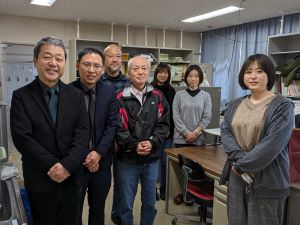
Kiyonao Sada MD PhD
Kazuyasu Chihara PhD
Kenji Takeuchi PhD
Yuri Chihara PhD
Satomi Yamamoto (secretary)
Research Outline
From cancer viruses to tyrosine kinases and signal transduction: The discovery of the oncogene v-Src and its tyrosine kinase in the Rouse sarcoma virus led to the study of intracellular signal transduction and the discovery of cellular tyrosine kinases that are expressed in normal tissues and regulate individual development and tissue growth and differentiation.
Evolutionary summit battle: Why do humans suffer from infectious diseases? As virus-host interactions, we have been promoting the study of host factors that affect the proliferation of hepatitis C virus, and have elucidated that tyrosine kinase Abl is required for the life cycle of HCV, especially for the formation of viral particles. In the future, it is expected to be applied to the control of viral infection using anti-cancer drugs. On the other hand, as for pathogen-host interactions, we have been studying host factors for pathogen infection, and have found that the adaptor protein 3BP2 is essential for the C-type lectin receptor (CLR) signaling pathway, which is known as a receptor for fungi and Mycobacterium tuberculosis. They are expected to expand their research to elucidate new innate immune signals mediated by the CLR.
International Exchange for Medical students (Undergraduate students)
Our laboratory conducts short-term exchange programs for medical students with overseas universities with which we have academic exchange agreements. The students learn about the unique medical care and medical research of each country and develop an international perspective through exchange with international students.
Since fiscal 2011, we have been conducting a program with the Faculty of Medicine, Airlangga University in Surabaya, Indonesia, to experience the forefront of clinical and basic research on infectious diseases in each country.
If you have read the papers published by our laboratory listed below and are interested in enrolling in graduate school from abroad, please send an email to me (Prof. Sada).
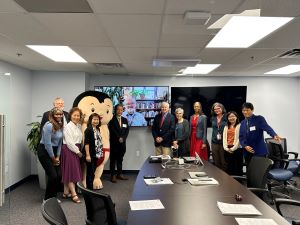
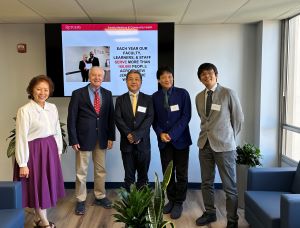
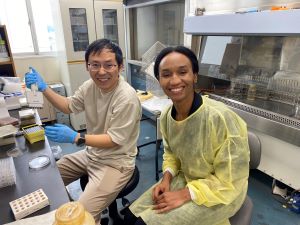
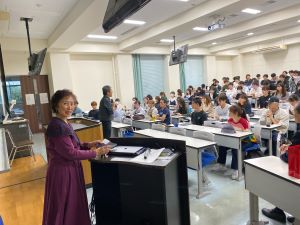
In September 2023, a delegation from the University of Fukui School of Medicine visited Rutgers University in the U.S. to introduce the medical education program at the University of Fukui and to tour educational facilities for medical students dispatched from the University .In July 2024, a medical student from Rutgers University came to the University of Fukui for basic and clinical training. In October 2024, Prof. Karen W. Lin, Associate Dean for International Exchange, visited the University of Fukui.
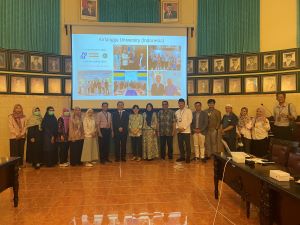
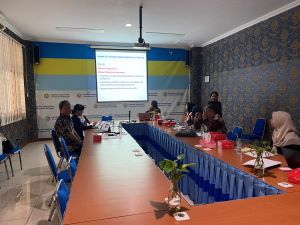
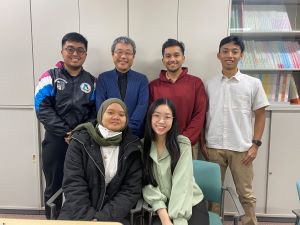
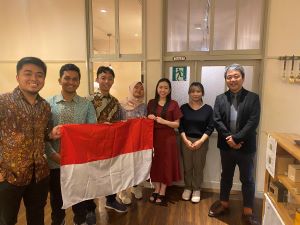
In January 2024, a delegation from the University of Fukui School of Medicine visited the Faculty of Medicine, Faculty of Nursing, and the Institute of Tropical Diseases at the University of Airlangga in Surabaya, Indonesia. In November 2024, five medical students from the University of Airlangga came to study at the University of Fukui.
Representative Original Papers
- Fu L, Takeuchi K, Chihara K, Feng W, and Sada K. Protein tyrosine kinase Src suppresses hepatitis C virus particle release through regulation of Ndrg1. J Biol Chem. 2026 Feb; 302(2):111125.
- Tsubokawa A, Chihara K, Chihara Y, Takeuchi K, Fujieda S, and Sada K. Adaptor protein 3BP2 regulates gene expression in addition to the ubiquitination and proteolytic activity of MALT1 in dectin-1-stimulated cells. J Biol Chem.
- Miyamoto D, Takeuchi K, Chihara K, Fujieda S, and Sada K. Protein tyrosine kinase Abl promotes hepatitis C virus particle assembly via interaction with viral substrate activator NS5A. J Biol Chem. 2022 Apr;298(4):101804. Epub 2022 Mar 4.
- Chihara K, Chihara Y, Takeuchi K, and Sada K. Adaptor protein 3BP2 regulates dectin-1-mediated cellular signalling to induce cytokine expression and NF-κB activation. Biochem J. 2022 Feb 17;479(4):503-523.
- Yamauchi S, Takeuchi K, Chihara K, Honjoh C, Kato Y, Yoshiki H, Hotta H, and Sada K. STAT1 is essential for the inhibition of hepatitis C virus replication by interferon-λ but not by interferon-α. Sci Rep. 2016 Dec 8;6:38336.